

Gedo Memory places 3rd on the AML Cycle 2 Commercial Products leaderboard
Results of the second Agent Memory Challenge are out. Gedo Memory placed 3rd on the Commercial Products leaderboard and 5th on the Closed-Source Methods leaderboard, both in Text Memory.
- Authors
- The Gedo team
- Published
- November 20, 2026
Abstract
On November 19, 2026, the second Agent Memory Challenge, organized by the China Society of Image and Graphics (CSIG), announced its results. Gedo Memory placed 3rd on the Agent Memory Leaderboard (AML) Commercial Products leaderboard for Text Memory, with an overall score of 62.28, and 5th on the Closed-Source Methods leaderboard for Text Memory. We are honored by the result. This post covers the benchmark, how we did on each capability, the system we submitted and why we value a public, unified evaluation of agent memory.
Keywords Agent memory · AML · Long-term memory · Memory evaluation · Gedo Memory
1This year’s challenge
Agents now do far more than answer one question at a time. More and more, they work with people across sessions and over long periods: past information has to be found again accurately, facts that have changed have to be updated, and past experience has to help with the task at hand. Yet every system uses different data, downstream models and scoring, so results are hard to compare. AML answers this with a unified evaluation protocol that records memory writes and retrieval, downstream answering, scoring and result review separately, so that methods and products are compared on the same terms and every result can be traced and verified[1][2].
The first leaderboard was published on August 12, 2026, with 136 teams from companies, universities and startups signed up. The second challenge was organized by the China Society of Image and Graphics (CSIG), hosted by Nanjing University, Zhejiang University, Datawhale and the CSIG Enterprise Liaison and Standardization Committee, and again run on the AML platform. More than 400 projects entered formal evaluation across three tracks (textual, coding and multimodal memory), each with open-source, closed-source and commercial products leaderboards[2].
Participants included teams from Alibaba, Alibaba Cloud, NetEase Games, Volcano Engine, Shopee, ZTE, OPPO, StepFun, KT, XPeng, MemoraX and OceanBase, along with university research groups, open-source contributors and independent developers; many projects from the first leaderboard came back. By November 18, content about the challenge had reached more than one million views across platforms, and the official website had passed ten million visits[2].
2Results
The Commercial Products leaderboard is drawn from the closed-source entries and covers memory products and services submitted by companies, so developers can see how mainstream commercial options actually perform[2].
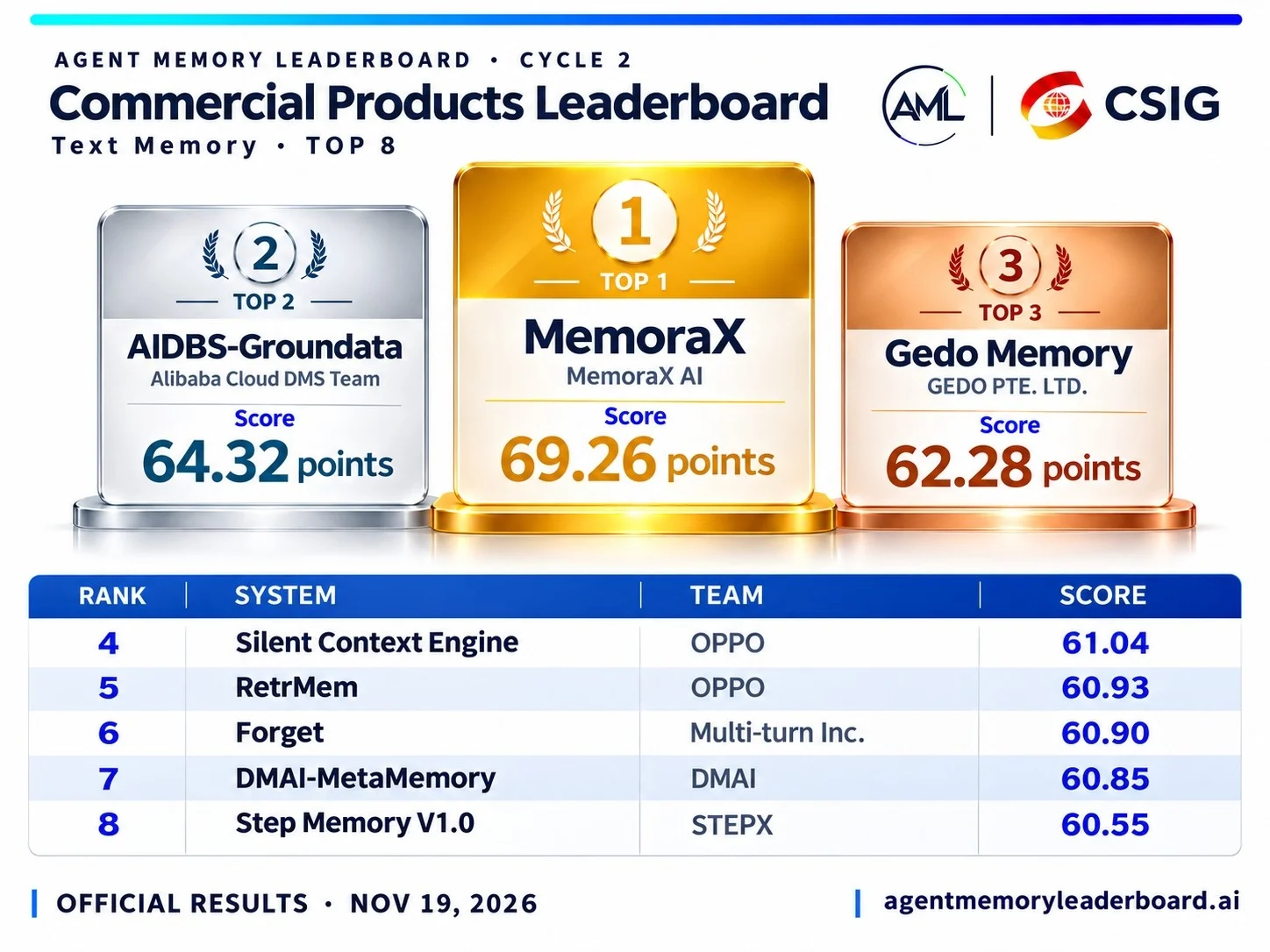
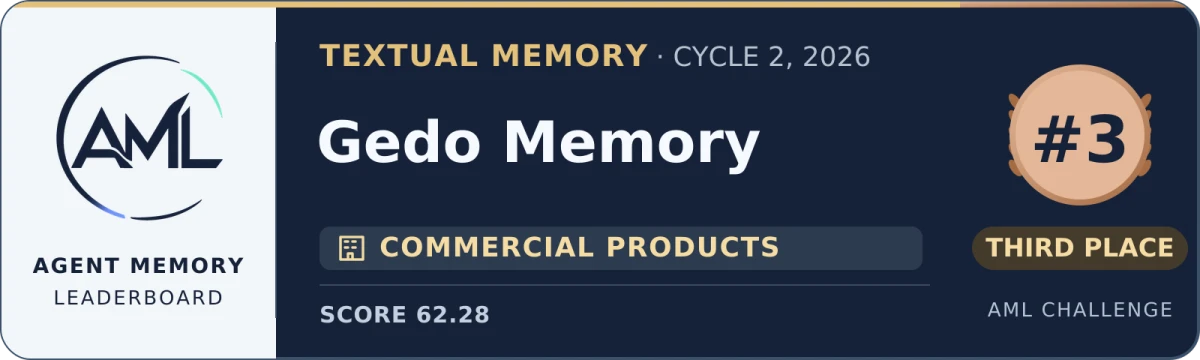
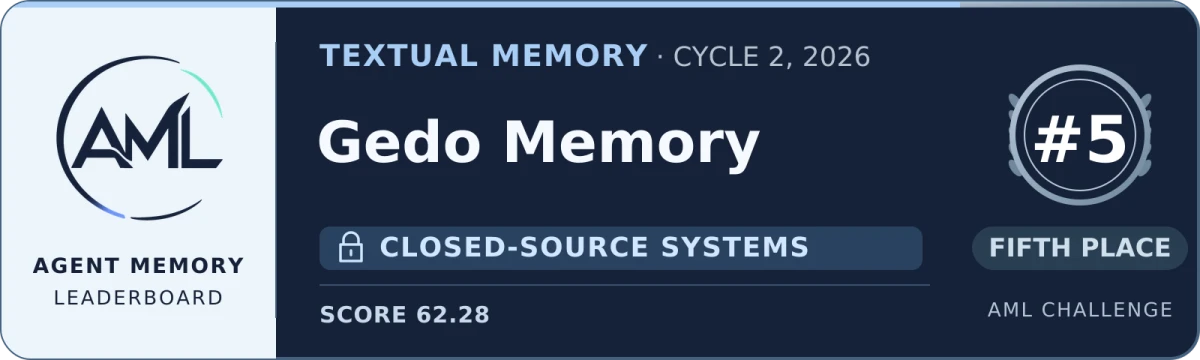
Gedo Memory placed 3rd on the Commercial Products leaderboard for Text Memory, with an overall score of 62.28; the same result placed 5th on the Closed-Source Methods leaderboard[3][4]. The cycle opened on September 20 and closed submissions on October 31. The organizers received 402 full evaluation runs and, after integrity, version and compliance review, published 292 valid leaderboard records; the textual track covers more than 6,000 evaluation instances[2].
3Capability breakdown
The Text Memory score is made up of eight top-level capabilities. The table shows Gedo Memory’s score and rank on the Commercial Products leaderboard for each (ranks taken column by column from the official public table):
| Capability | Gedo Memory | Rank (commercial) | Top score |
|---|---|---|---|
| A Explicit fact recall | 66.27 | 3 | 70.85 |
| B Relational / multi-hop reasoning | 58.23 | 3 | 64.40 |
| C Time and event sequences | 62.65 | 4 | 67.05 |
| D Memory governance | 73.20 | 12 | 78.10 |
| S Streaming memory | 52.29 | 12 | 63.11 |
| G In-context learning, rules and procedures | 58.65 | 15 | 61.78 |
| E Personalization and care | 41.58 | 18 | 54.70 |
| H Epistemic safety and privacy | 62.77 | 49 | 81.98 |
Source: AML Cycle 2 Commercial Products leaderboard, Text Memory, public table[3]
Fact recall, multi-hop reasoning and time sequences all ranked in the top four: finding the right evidence and handing it to the downstream model in a usable order is the strongest part of this version. Epistemic safety and privacy is where the gap to the leaders is widest. The more complete the context a memory layer hands to the model, the harder it is to keep back what should not be said, and that is where most of our work is going now.
As the organizers note, an overall rank reflects performance across this benchmark as a whole, not an advantage on every capability or in every use case[2]. A breakdown says more than a single score about what a memory system does well and what it still lacks.
4The system we submitted
Gedo Memory is the memory layer of Gedo, a personal AI that stays with you and keeps remembering you over time. The memory layer decides what it remembers, what it updates, what it forgets and when it says nothing. The submitted version shares its memory code with the product, with extraction depth, evidence volume and ordering tuned for the AML Add / Search interface. The main design choices:
- Two layers: a verbatim layer keeps the original text of every conversation, and an extracted layer keeps the facts, preferences and events drawn from it. Retrieval reads both, so every extracted conclusion can be checked against what was actually said.
- Organize on write: extraction finishes before each write returns, so new content is searchable right away.
- Evidence first: the context handed to the downstream model leads with evidence, keeps dates and speakers, and adds verbatim highlights.
- Model reranking: retrieved candidates are reranked once by a model before they are returned in order of relevance.
- Per-user isolation: each user’s memory is stored and searched on its own.
Extraction and reranking use Claude Haiku 5.5; embeddings use qwen3.7-text-embedding (1,024 dimensions). The answering and judging models are fixed by the platform.
5Why this kind of benchmark matters
Memory in a personal AI is more than finding a sentence again. It has to remember a person across sessions and over long periods, keep up with facts that have changed, forget what it was asked to forget, and know what should not be said out loud. These abilities are hard to compare through each team’s own tests: the data, downstream models and scoring all differ, and the results do not line up.
Under AML’s unified protocol, the only thing that differs between systems is memory itself, and the evaluation code is public on GitHub[5]. The new streaming memory evaluation in this cycle tests whether a system keeps its memory current while information keeps arriving, which is exactly what a personal AI faces every day. We share the direction of this benchmark and are grateful for a mirror we can hold our work up to.
6Acknowledgments
Thank you to the China Society of Image and Graphics (CSIG), Nanjing University, Zhejiang University, Datawhale and the CSIG Enterprise Liaison and Standardization Committee for organizing the challenge, and to the AML evaluation team and reviewers for their patient support through onboarding, evaluation runs and result review. Congratulations to every team on this cycle’s leaderboards. According to the organizers, the award ceremony is planned for December 5 during the CSIG Challenge finals[2].
Full leaderboards, capability scores and participation guides are on the AML website[1].
References
- [1]Agent Memory Leaderboard (AML) website
- [2]Agent Memory Leaderboard (2026). Results of the second CSIG AML Memory Challenge (in Chinese). WeChat official account, November 19, 2026
- [3]AML Cycle 2 · Text Memory · Commercial Products leaderboard
- [4]AML Cycle 2 · Text Memory · Closed-Source Methods leaderboard
- [5]AML evaluation protocol and open-source repository (GitHub)