


Profile: how Gedo understands you
Memory › Profile is Gedo’s structured understanding of you. The top line shows your name, job, where you live, your north star and Completeness, which reflects how much of the core is filled in, in four levels: Just met, Familiar, Close friend and Gets you.
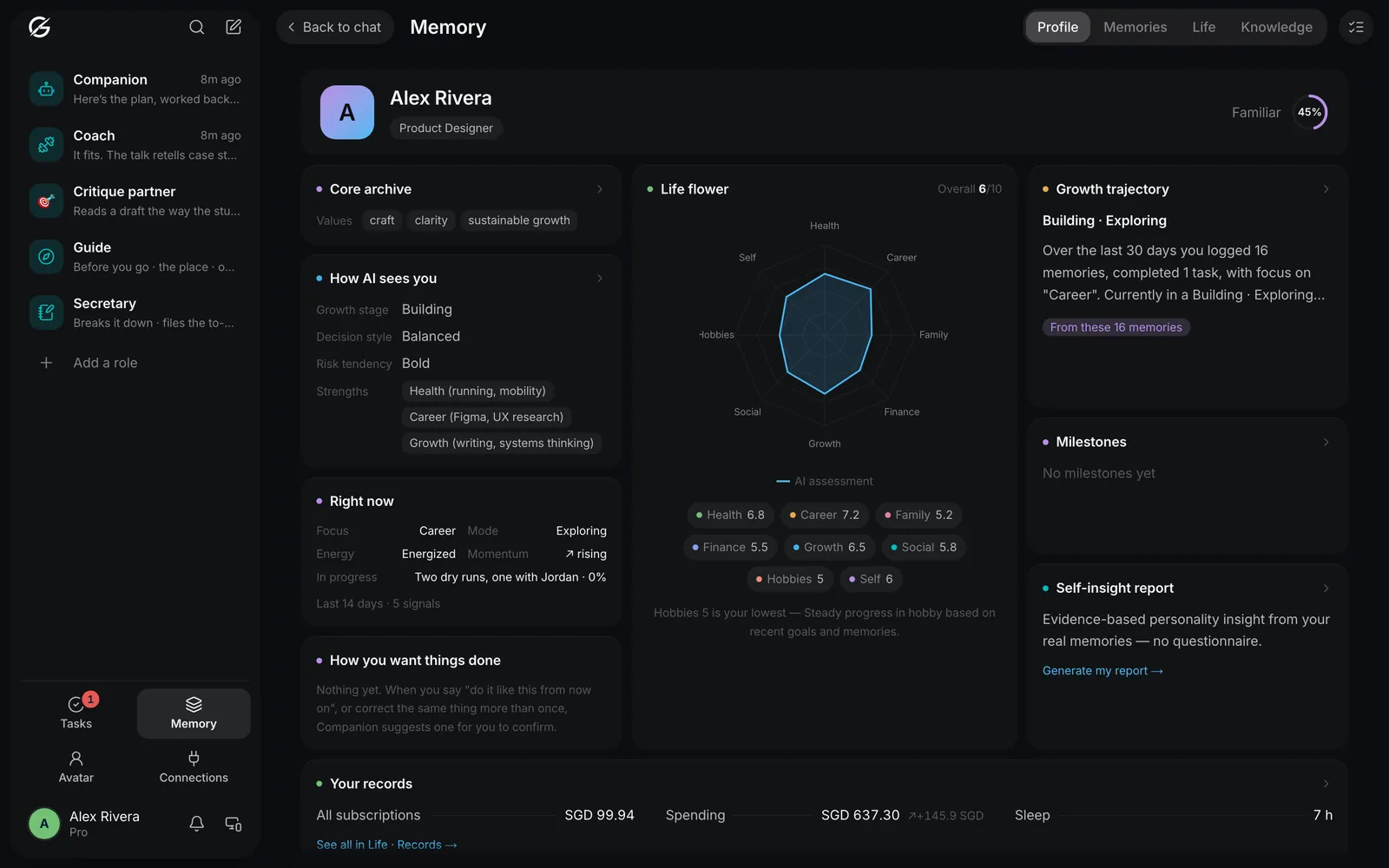
- Core archive: values, limits, vision and challenges. The most stable you, remembered in every conversation.
- How AI sees you: growth stage, decision style, risk tendency, strengths and things to improve; open a conclusion to see which memories it came from.
- Right now: your recent focus, mode, energy, mood and momentum.
- Growth trajectory: the stage you’re in, key changes, next steps, risks and opportunities.
- Self-insight report: your personality spectrum and how you operate, inferred from your memories with evidence for each item; when a few items are unclear, it asks you some short questions first. It is for self-exploration only, not a clinical assessment.
- Memory status: how many memories you have and how many are waiting for you, with Tidy up now.
How the profile changes
The profile is only updated when memory is organized: every night, once a week, and when you choose Clean up now on the Profile page. A new statement that contradicts your profile doesn’t overwrite it; it goes to To review as a profile update for you to decide.
Overnight edits are listed in Changed by Gedo, where each one has Restore this. The profile also shows what Companion would still like to know, which you can simply mention next time you chat.
Life flower: eight areas
The Life flower in the middle of the profile scores eight areas of life: Health, Career, Family, Finance, Growth, Social, Hobbies and Self. Each has five levels (Needs care, Sprouting, Growing, Thriving and In bloom), and an area without enough evidence shows Not enough signal instead of a forced score.
Scores draw on your memories from the last 30 and 90 days, goal progress and how much has settled in, plus your own rating where you’ve given one; the AI can only fine-tune around the rule-based score. The chart shows AI assessment and Self-rated as two layers.
The eight areas are assessed every Monday and recalculated when you choose Clean up now. To see how each has moved over recent weeks, open Trends in Memory › Memories › Cognition tree.
Cards: one for each person and thing
Memory › Life › People & things holds a card for each person, pet, object, place, organization and event that keeps coming up, in four groups: People, Pets & things, Places & orgs and Events. A card holds facts such as “Mom: birthday = March 8”, and related memories hang under it.
You can create a card yourself with Add card, and for people and things you mention again and again, Gedo counts mentions by name across your recent memories when it organizes overnight and, once there are enough, sends a card suggestion to To review. People named in your profile are suggested too, and a card is created only when you accept. A suggestion you turned down isn’t made again for six months, and accepted imports are counted right away instead of waiting for the night.
When a field on an existing card is empty and Gedo is confident, it fills it in, and you can undo that; other new facts appear under New from Companion in the card details, to Adopt or Ignore. Merge two duplicate cards with Merge…, which can’t be undone.
Turn on Hide from AI on a card and Companion no longer reads it or refers to it in chat. Available to public avatar is off by default; turn it on and your public avatar may mention the card’s facts to visitors it recognizes.
Cognition tree and mastery
Memory › Memories › Cognition tree distills the skills in your memories into a tree: the roots are principles and values, trunks are domains, branches are skill families and leaves are specific skills. Related mental models and cross-links sit alongside.
Each skill has a mastery percentage across five levels: Novice, Advanced beginner, Competent, Proficient and Expert. Mastery is calculated from the evidence behind that skill; open a leaf to see the evidence and write down your own thoughts.
The tree grows only from your memories and profile, not from files in your knowledge base; to make a file count as evidence, choose Extract to memories on it and confirm the results. Re-distill rebuilds the tree from your current memories.
Milestones and how-tos
Life events marked as milestones on the timeline are gathered into the Milestones card on your profile, next to the Lessons learned distilled from your memories. If one wasn’t picked up automatically, choose Mark as milestone on that memory in the timeline.
The How you want things done card holds processes and formats you set. When you say “do it like this from now on”, or correct the same thing more than once, Companion suggests one for you to confirm; once accepted, the AI follows it when the topic comes up, and each one shows What you said and can be deleted.